As dawn broke on International Women's Day 2026, the United States found itself at the center of a geopolitical firestorm that has spilled from the Persian Gulf to the streets of Cleveland. While President Donald Trump demands the "unconditional surrender" of Iran amidst a ferocious new air campaign, tens of thousands of demonstrators are mobilizing across American cities to protest the administration's widening war and reproductive rights policies. In a simultaneous display of aggressive foreign policy, the White House has formally inaugurated a controversial 17-nation "counter-cartel" coalition, pledging US missile strikes to Latin American allies to eradicate drug lords.
Operation Epic Fury: The War on Iran Enters a Deadly Phase
The conflict in the Middle East has spiraled into what military analysts are calling the most significant interstate confrontation of the 21st century. Following the February 28 launch of "Operation Epic Fury," a joint US-Israeli campaign that claimed the life of Supreme Leader Ali Khamenei, hostilities have intensified dramatically over the last 48 hours. Pentagon officials confirmed Saturday that US forces have now destroyed over 300 ballistic missile launchers inside Iran, aiming to dismantle the regime's ability to retaliate.
However, the humanitarian cost has become a flashpoint for global outrage. A disputed missile strike on a girls' elementary school in Minab, Iran, which killed over 100 students and teachers, has drawn fierce condemnation. While Tehran blames the "American terrorist army," President Trump vehemently denied responsibility during a press gaggle aboard Air Force One, asserting without evidence that the tragedy was the result of a misfired Iranian munition. "They have no accuracy whatsoever," Trump told reporters, even as he reiterated his ultimatum for Tehran's total capitulation.
Iran Strikes Back at Gulf Allies
In retaliation, Iranian forces have launched waves of drone and missile attacks targeting US bases in Kuwait and the UAE. Although US Central Command reports intercepting 90% of incoming threats, the specter of a broader regional war looms large. The closure of the Strait of Hormuz remains a threatened "nuclear option" for Tehran, a move that could send global oil prices skyrocketing and drag European powers into the fray.
Mass Protests on International Women's Day 2026
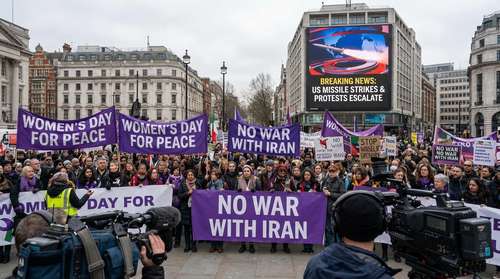
The escalation abroad has poured gasoline on an already volatile domestic landscape. What began as an annual observance of International Women's Day has morphed into a nationwide "Free America Walkout." Organizers estimate that over a million protesters will take to the streets in major cities including Washington D.C., San Jose, and Chicago, driven by a convergence of anti-war sentiment and anger over the administration's domestic agenda.
In Cleveland, Ohio, the march has taken on particular significance. Led by Women's March Cleveland, activists are gathering at Market Square Park not just to champion reproductive rights, but to explicitly denounce the bombing of the Minab school. "This is a movement, not a moment," declared organizer Kathy Wray Coleman. For many attendees, the war in Iran is inextricably linked to the "Project 2025" policies they argue are stripping women of their autonomy at home. Signs reading "Books Not Bombs" and "Hands Off Our Bodies, Hands Off Iran" are expected to dominate the skyline as protesters march through downtown corridors.
Trump’s ‘Counter-Cartel’ Coalition: Missiles for Drug Lords
While managing a war in the Middle East, President Trump opened a second front in the Western Hemisphere on Saturday. Hosting a summit at his Doral golf club in Miami, he formally launched the "Americas Counter-Cartel Coalition," a security pact involving 17 right-leaning Latin American and Caribbean governments, including Argentina, Ecuador, and El Salvador.
The President's rhetoric was stark and militaristic. Describing drug cartels as the "cancer" of the hemisphere, Trump offered unprecedented US military support to the signatory nations. "We’ll use missiles. You want us to use a missile? They’re extremely accurate," Trump told the assembled leaders. He vividly pantomimed a strike, adding, "‘Piu,’ right into the living room. That’s the end of that cartel person."
A New Monroe Doctrine?
This aggressive posture, which some critics are calling the "Donroe Doctrine," signals a shift toward direct US military intervention in Latin America. The coalition agreement reportedly includes provisions for "hard power" operations, allowing US assets to target cartel infrastructure across borders. Security experts warn that while this may disrupt narco-trafficking routes, it risks destabilizing fragile democracies and inciting backlash reminiscent of the Cold War era. For the administration, however, it represents a fulfillment of campaign promises to secure the "near abroad" with the same ferocity applied to adversaries in the Middle East.
A Nation Divided on Two Fronts
As Sunday unfolds, the contrast between the administration's military offensives and the civic unrest on American streets could not be sharper. The dual escalations—missiles in the Gulf and the Caribbean—paint a picture of a presidency betting everything on overwhelming force. Yet, the massive turnout expected for the Cleveland Women's March and similar rallies suggests that for millions of Americans, the battle is not just about foreign enemies, but about the soul of the nation itself.