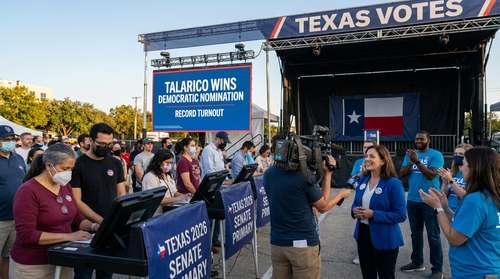
Newly released official data confirmed on Friday has dramatically shifted the national political landscape following the Texas 2026 Senate primary. According to close-to-final tallies verified this week, voter participation shattered historical expectations, sending shockwaves through both major parties. In a stunning display of grassroots enthusiasm, Texas Democrats cast over 2.3 million ballots, officially outpacing Republican turnout for the first time in recent midterm history. The finalized numbers contextualize a historic cycle that culminated in a decisive James Talarico victory for the Democratic nomination, while a fractured Republican electorate forced incumbent Senator John Cornyn and Attorney General Ken Paxton into a bitter, high-stakes runoff.
Texas Democratic Turnout Record Reaches Historic 2.3 Million
For decades, conservative dominance in the Lone Star State has relied on a consistent, structural voter participation advantage. However, the latest 2026 midterm election results suggest that the traditional mathematical models are changing. Fresh data released in the last 48 hours confirms that approximately 4.5 million Texans voted in the early March primaries, with progressive voters driving an unprecedented surge.
The Texas Democratic turnout record now stands at an astonishing 2.3 million votes, narrowly eclipsing the nearly 2.2 million ballots cast on the Republican side. To understand the magnitude of this shift, one must look at recent historical benchmarks. During the 2022 midterms, Democratic primary participation hovered around just 1.07 million voters. This year's turnout more than doubled that figure, indicating that the party's base is highly motivated by the national political climate and a fiercely competitive primary slate.
Political analysts note that this is the first time Democratic primary participation has surpassed Republican numbers in a midterm cycle in over two decades. Analysts point to unusually full local ballots and a high-profile Senate race as the primary catalysts for the spike in voter engagement. If this momentum translates into general election enthusiasm, it could serve as the foundation for a genuine Texas blue wave 2026.
James Talarico Victory: How He Built a Statewide Coalition
The battle for the progressive nomination was widely viewed as a clash of rising political stars with highly distinct bases of support. When the final votes were counted, State Representative James Talarico secured the nomination by capturing 52.4% of the electorate, successfully fending off a formidable challenge from U.S. Representative Jasmine Crockett, who earned 46.2%.
The James Talarico victory was ultimately secured through a calculated geographic and demographic strategy that proved highly effective across the state's sprawling and diverse voting districts. While Crockett dominated in her home territory of Dallas and maintained a massive lead in East Texas areas with high concentrations of Black voters, Talarico managed to run up the margins elsewhere. Talarico secured robust victories in liberal strongholds like Austin and San Antonio.
The Impact of the Texas Latino Voter Surge
Perhaps the most critical element of the Democratic primary was the Texas Latino voter surge in the southern part of the state. Talarico heavily invested in outreach across the Rio Grande Valley and successfully captured key demographics in heavily Hispanic counties like Hidalgo and Cameron. This multi-regional coalition ultimately provided the cushion Talarico needed to avoid a runoff and immediately pivot his focus toward the general election, unifying the party base in the process.
The John Cornyn Ken Paxton Runoff Set for May 26
While Democrats coalesce behind their nominee, the Republican establishment is bracing for an extended and incredibly expensive civil war. The highly anticipated Texas 2026 Senate primary failed to produce a definitive GOP nominee, highlighting deep ideological fractures within the party. Incumbent Senator John Cornyn narrowly led the field with 41.9% of the vote, followed closely by embattled Texas Attorney General Ken Paxton at 40.7%. U.S. Representative Wesley Hunt secured a notable 13.5%, pulling enough support away from the frontrunners to prevent an outright majority.
Because neither candidate crossed the critical 50% threshold, the state is now locked into a John Cornyn Ken Paxton runoff officially scheduled for May 26. The financial toll of this primary has been staggering. It has already become the most expensive Senate primary contest in state history, with nearly $99 million spent across the races by mid-February. Cornyn's advertising alone accounted for nearly $59 million of that total.
Despite Cornyn's incumbency advantage and massive war chest, political consultants warn that the May runoff will heavily favor the most dedicated grassroots voters. Paxton has retained fierce loyalty from the conservative base despite his long history of legal troubles, setting the stage for a volatile and unpredictable showdown.
Looking Ahead: Shaping the 2026 Midterm Election Results
As the final data from the Texas 2026 Senate primary is codified this week, national political committees are aggressively reevaluating their electoral maps. History remains a formidable obstacle; no Democrat has won statewide office in Texas since 1994. The closest modern attempt was in 2018, when Beto O'Rourke fell short by less than three points against Senator Ted Cruz.
However, the verified 2.3 million vote milestone demonstrates that the necessary infrastructure exists to mount a serious, fully-funded challenge in November. The general election will present a stark contrast in preparation. Talarico now has the luxury of several months to build a unified campaign operation and war chest. Conversely, his future Republican opponent—whether the traditional conservative Cornyn or the populist Paxton—must spend millions fighting through a bruising May runoff before pivoting to the general election.
With the balance of the U.S. Senate hanging by a single seat in a deeply divided Washington, the eventual 2026 midterm election results in Texas may very well dictate the legislative direction of the entire country. For now, Democrats are celebrating a historic turnout victory, while Republicans prepare for a grueling spring battle.