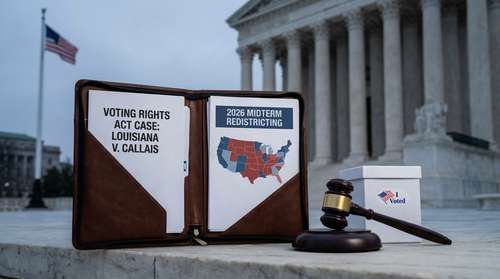
The political landscape of the United States hangs in the balance today, April 17, 2026, as the nation anticipates a landmark Supreme Court Voting Rights Act 2026 decision. The justices are poised to release their final opinion in the fiercely contested Louisiana v. Callais case, an outcome that could fundamentally rewrite the rules for minority voter representation. Should the conservative-leaning court side with the plaintiffs, the decision would severely limit the creation of minority-opportunity districts. This high-stakes legal showdown arrives at a critical juncture, directly intersecting with intense preparations for the fast-approaching fall campaigns and determining which party will ultimately control a narrowly divided Congress.
Decoding the Louisiana v Callais Ruling
The path to today's highly anticipated Louisiana v Callais ruling has been anything but straightforward. The conflict stems from Louisiana's congressional maps following the 2020 census, where the state's Republican-led legislature initially drew just one majority-Black district out of six, despite Black residents making up nearly a third of the population. After federal courts determined the map likely violated the Section 2 Voting Rights Act, the legislature adopted a new map featuring two majority-Black districts.
However, this second map prompted a reverse challenge from a group of white voters. They argued that lawmakers improperly prioritized race over race-neutral redistricting principles, thereby violating the Equal Protection Clause of the 14th Amendment. The Supreme Court first heard the case in March 2025 but took the rare step of scheduling a re-argument for October 15, 2025. Now, the justices aren't just evaluating a single state's map; they are examining whether the longstanding requirement to intentionally create minority-opportunity districts remains constitutional.
Immediate Impact on 2026 Midterm Election Redistricting
Election analysts warn that the timing of this Supreme Court Voting Rights Act 2026 decision could throw the upcoming election cycle into chaos. A ruling that guts Section 2 protections would likely trigger widespread 2026 midterm election redistricting across multiple states. Lawmakers in states with unified partisan control could seize the opportunity to redraw congressional lines for political advantage right before voters head to the polls.
According to a recent 2026 analysis by the nonpartisan group Issue One, an adverse ruling this spring could lead to the rapid redrawing of up to eight congressional seats nationwide. States such as Florida, Georgia, Missouri, South Carolina, and Tennessee have already demonstrated an appetite for aggressive map adjustments. A SCOTUS voting rights decision that limits the application of Section 2 would remove a significant legal barrier that currently prevents partisan mapmakers from dismantling minority-heavy districts.
The Threat of New Federal Election Law Legal Challenges
Implementing new congressional boundaries in late April or May presents massive logistical hurdles. As primary season is already well underway, any sudden legislative attempts to overhaul district lines will inevitably spawn a massive wave of federal election law legal challenges. Voting rights advocates and civil rights organizations have already pre-drafted injunctions and lawsuits, preparing to fight any mid-cycle map changes that threaten to disenfranchise Black voters.
Election administrators are simultaneously sounding the alarm about the practical nightmare of altering districts this late in the calendar. Modifying ballot designs, updating voter registration databases, and communicating new polling locations to the public requires months of preparation. For those following the latest 2026 congressional race news, the potential for administrative breakdowns and prolonged court battles makes the upcoming midterms one of the most unpredictable in modern American history.
The Future of the Section 2 Voting Rights Act
For over five decades, the Section 2 Voting Rights Act has served as a cornerstone of American civil rights, designed to guarantee that racial minorities have a meaningful opportunity to elect representatives of their choice. Legal scholars note that the Supreme Court has steadily chipped away at the VRA over the last decade, most notably in the 2013 Shelby County v. Holder decision that dismantled federal preclearance requirements.
If the justices use the Louisiana v. Callais framework to declare race-conscious districting unconstitutional, it would mark a catastrophic blow to minority representation at all levels of government. Such a decision would not only reshape the House of Representatives for the remainder of the presidential term but would also alter state legislature and local city council maps across the country.
What to Watch for in the Final Supreme Court Decision
As legal teams and political strategists refresh the Supreme Court's docket this morning, all eyes remain fixed on the specific language the justices will employ. Will the court issue a narrow ruling strictly focused on Louisiana's District 6, or will it issue a sweeping mandate that fundamentally invalidates the results standard of the VRA?
The stakes for the November elections cannot be overstated. A decisive blow to minority-opportunity districts will force both major political parties to immediately pivot their campaign strategies, reallocate millions of dollars in advertising funds, and rethink their paths to a House majority. The impending Louisiana v Callais ruling represents far more than a legal dispute over geographic boundaries; it is a generational battle over the definition of fair representation in American democracy.