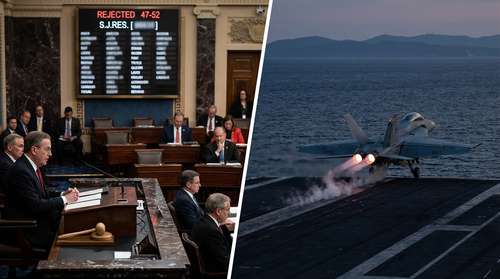
WASHINGTON — In a decisive late-night vote on Thursday, the U.S. Senate narrowly rejected a bipartisan war powers resolution intended to halt President Trump’s escalating military campaign against Iran. The measure failed 47-52, effectively granting the administration a legislative green light to continue what the Pentagon has dubbed "Operation Epic Fury." The vote comes as the conflict enters its sixth volatile day, with joint U.S.-Israel strikes pounding targets across the Islamic Republic and global oil markets reeling from the uncertainty.
Senate War Powers Resolution Fails to Pass
The high-stakes roll call on the Senate floor marked the first major legislative challenge to President Trump’s authority since hostilities erupted earlier this week. Sponsored by Senator Tim Kaine (D-VA), the resolution sought to invoke the 1973 War Powers Act to force a withdrawal of U.S. forces from hostilities unless explicitly authorized by Congress. Despite a passionate floor debate regarding the constitutional separation of powers, the measure fell short of the simple majority needed to advance.
The final tally of 47-52 largely followed party lines but featured two notable defections that underscored the complex political dynamics of the 2026 Middle East news cycle. Senator Rand Paul (R-KY) was the sole Republican to cross the aisle in support of the measure, maintaining his long-standing libertarian stance against unauthorized foreign interventions. Conversely, Senator John Fetterman (D-PA) broke with his Democratic colleagues to vote against the resolution, arguing that hamstringing the Commander-in-Chief during an active military exchange would endanger deployed service members.
"This was not a vote about whether Iran is a bad actor—we all agree they are," Senator Kaine told reporters immediately following the defeat. "This was a vote about whether we are a nation of laws where Congress declares war, or whether we surrender that most solemn power to the executive branch forever."
Escalation in the Middle East: Day Six
The legislative battle played out against a backdrop of rapidly intensifying violence. The conflict, sparked by a series of surprise joint U.S.-Israel airstrikes that began on February 28, has fundamentally altered the security architecture of the region. Pentagon officials confirmed on Thursday that the operation has now successfully targeted key command-and-control infrastructure, though the administration has remained tight-lipped about the full extent of the damage.
Casualties and Retaliation
The human cost of the conflict is already climbing. The Department of Defense confirmed earlier today that the U.S. death toll has risen to six service members following a drone attack on a logistics hub in Kuwait. Meanwhile, Iranian state media is reporting hundreds of casualties in Tehran and Isfahan, fueling anti-American demonstrations across the region. The death of Iran's Supreme Leader Ayatollah Ali Khamenei in an airstrike earlier this week has left a power vacuum that intelligence analysts warn could lead to unpredictable and erratic retaliation from the Islamic Revolutionary Guard Corps (IRGC).
Executive Branch War Authority vs. Congressional Oversight
The debate over the war powers resolution vote highlighted a widening chasm between the executive branch and lawmakers regarding war authority. The White House has vigorously defended the strikes as a necessary act of self-defense under Article II of the Constitution, citing "imminent threats" from a reconstituted Iranian nuclear program. However, critics argue the administration has yet to provide declassified evidence to support these claims.
"The President has the absolute authority to defend this nation against clear and present dangers," said Senator Lindsey Graham (R-SC) during the floor debate. "Attempting to micromanage a war from the Senate floor while our pilots are in the air is not just unconstitutional; it is dangerous."
Conversely, the rejection of the measure has alarmed constitutional scholars who see it as a further erosion of the legislative branch's check on military power. With the resolution defeated, the Trump administration faces no immediate domestic legal hurdles to expanding the scope of the conflict, which President Trump suggested in a press briefing could last "another four to five weeks."
Global Economic Impact: Oil and Markets
Beyond the geopolitical fallout, the U.S. Israel Iran conflict is sending shockwaves through the global economy. As news of the Senate vote broke, Brent crude oil prices spiked another $4, surpassing $78 per barrel for the first time in months. The sharp rise reflects growing market anxiety that Iran may attempt to close the Strait of Hormuz—a critical chokepoint for global energy supplies—in retaliation for the continued U.S. offensive.
Major Asian markets tumbled in early Friday trading, reacting to the prospect of a prolonged engagement. "The markets hate uncertainty, and the Senate's refusal to put guardrails on this conflict guarantees weeks, if not months, of extreme volatility," noted financial analyst Sarah Jenkins. With inflation already a concern for the 2026 midterms, the economic ramifications of a protracted war could prove to be a significant political liability for the incumbent party.
As the sun rises on the seventh day of the conflict, all eyes now turn to the House of Representatives, where a similar resolution is expected to be introduced. However, given the Senate's rejection, the path to halting the military campaign remains virtually nonexistent, leaving the trajectory of the war firmly in the hands of the White House.