
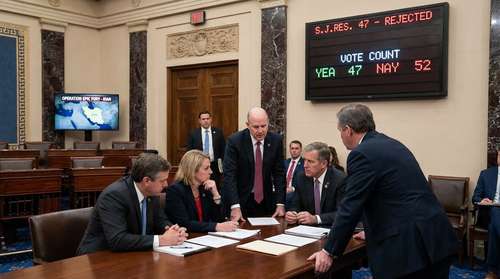
The U.S. Senate narrowly rejected a crucial War Powers Resolution on Wednesday, effectively authorizing President Donald Trump to continue the escalating military campaign known as "Operation Epic Fury" against Iran. In a tense 47-52 vote that defied traditional party lines, a coalition of isolationist Republicans and anti-war Democrats failed to secure the majority needed to reclaim congressional authority over the widening conflict. The decision clears the path for the Pentagon to strike deeper into inland Iranian infrastructure, sending shockwaves through global energy markets and raising fears of a prolonged regional war.
Senate Vote Confirms Executive War Powers Amidst Conflict
The legislative showdown on Capitol Hill marked the most significant challenge yet to President Trump's authority since the surprise launch of Operation Epic Fury late last month. Sponsored by Senator Tim Kaine (D-Va.), the resolution sought to invoke the 1973 War Powers Act to force a withdrawal of U.S. forces from hostilities within 30 days. However, the measure fell short, with the final tally resting at 47-52 after a dramatic roll call that saw key defections on both sides of the aisle.
Political observers were stunned by the vote's composition, which highlighted a fracturing of the standard partisan divide. While the majority of Democrats supported the resolution, seeking to check what they termed an "unconstitutional war," they were abandoned by Pennsylvania Senator John Fetterman. Fetterman, breaking sharply with his progressive colleagues, voted against the measure, arguing that handcuffing the Commander-in-Chief mid-operation would endanger U.S. troops already on the ground. Conversely, Republican Senator Rand Paul (R-Ky.) crossed the aisle to vote in favor of the resolution, warning against "endless wars" without clear objectives.
"This vote was not just about Iran; it was a referendum on the Constitution," Senator Paul told reporters shortly after the measure failed. "By abdicating our duty to declare war, the Senate has effectively written the President a blank check for Operation Epic Fury." The failure of the resolution means that for the foreseeable future, the executive branch retains full discretion over military strategy in the Persian Gulf, a reality that has already emboldened the administration to announce new targets.
Operation Epic Fury: Updates and Military Objectives
With the legislative hurdle cleared, the Pentagon has wasted no time in expanding the scope of Operation Epic Fury. Launched initially as a series of retaliatory airstrikes following attacks on U.S. assets in the region, the operation has morphed into a sustained air and naval campaign aimed at dismantling Iran's ballistic missile capabilities and nuclear infrastructure. Defense officials confirmed early Thursday that U.S. Central Command (CENTCOM) had initiated a "Phase Two" bombardment strategy, targeting command-and-control centers deep within Tehran and Isfahan.
Reports from the ground indicate that the strikes have been devastating. Intelligence assessments leaked to major news outlets suggest that the initial waves of the operation may have successfully targeted high-ranking Iranian leadership, with unverified reports circulating about the status of Supreme Leader Ali Khamenei. The Pentagon has yet to officially confirm these specific claims, but the intensity of the strikes suggests a decapitation strategy intended to induce regime collapse.
US Casualties and Retaliation Risks
The cost of the conflict is already being felt at home. The Department of Defense confirmed the identities of several U.S. service members killed in the opening days of the operation, including Army Reserve Capt. Cody A. Khork and Sgt. 1st Class Noah L. Tietjens. Their deaths have galvanized support for the operation among hawks in Congress, who argue that withdrawal now would dishonor their sacrifice. However, critics warn that the expanded strikes invite massive retaliation. Iran has already fired barrages of missiles at Israel and U.S. bases in the Gulf, and intelligence analysts warn that sleeper cells or proxy groups could attempt asymmetric attacks on Western targets in the coming days.
Global Markets React to US-Iran Conflict News
The geopolitical instability has triggered immediate volatility in global financial sectors. Oil prices surged to over $115 per barrel immediately following the news of the Senate vote, as traders priced in the likelihood of a protracted conflict disrupting the Strait of Hormuz—a critical chokepoint for global oil supply. Energy analysts predict that if Iran follows through on threats to mine the strait, prices could spike further, potentially triggering a global recession.
"The market was hoping for a de-escalation signal from the Senate," explained energy strategist Sarah Jenkins. "Instead, this vote is being interpreted as a green light for escalation. We are entering uncharted territory for energy security." European markets also dipped, reflecting anxiety over potential refugee crises and further supply chain disruptions.
What's Next for the War Powers Resolution 2026 Debate?
Despite the defeat in the Senate, the battle over war powers is unlikely to end. House progressives are reportedly drafting a new, more narrowly tailored resolution hoping to attract libertarian Republicans who voted against the Senate version. However, with the Senate explicitly backing the President's current course, the political momentum has shifted decisively in favor of the administration. For now, Operation Epic Fury proceeds without legislative guardrails, leaving the trajectory of the war solely in the hands of the White House and the Pentagon.