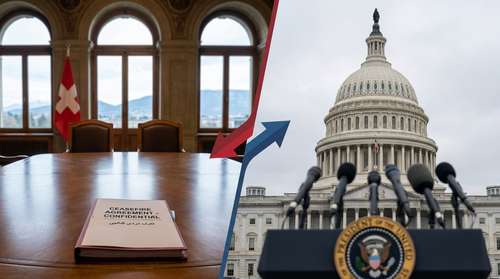
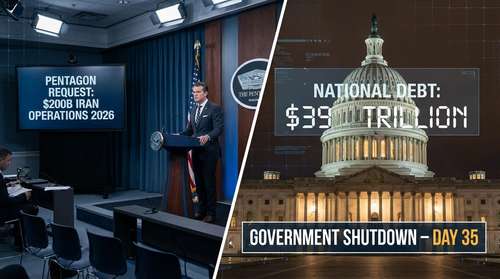
WASHINGTON — Defense Secretary Pete Hegseth’s staggering $200 billion Pentagon emergency request to fund the ongoing military campaign in Iran has set off a political shockwave. This monumental ask for Iran war funding 2026 arrives at a precarious moment for the nation’s finances, colliding directly with the stark reality that the US national debt 39 trillion milestone was just breached. To complicate matters, lawmakers are already paralyzed by a 35-day partial government shutdown, leaving essential homeland security personnel working without pay.
The Pentagon Emergency Request and Operation Epic Fury
Secretary Hegseth formally addressed the monumental funding package during a recent Pentagon press briefing. Defending the administration's financial needs for the ongoing joint US-Israeli offensive, Hegseth was blunt. "Obviously it takes money to kill bad guys, so we're going back to Congress and folks there to ensure that we're properly funded for what's been done, for what we may have to do in the future," he told reporters. While the initial figure floating around Capitol Hill stands at a staggering $200 billion, Pete Hegseth Iran operation updates indicate that the final number "could move" depending on battlefield requirements.
The sheer scale of the request has caught many lawmakers off guard. The military is already heavily funded, having received a massive $150 billion injection from last year's sweeping tax and spending legislation. However, White House officials insist this supplemental cash is absolutely necessary to replenish American munition stockpiles and sustain the broader regional strategy.
Fiscal Crisis as US National Debt Hits $39 Trillion
The timing of the administration's appeal could not be more challenging for fiscal conservatives. Just days ago, the Treasury Department confirmed the U.S. national debt officially crossed the $39 trillion threshold. The borrowing trajectory has steepened dramatically, with the total debt jumping an astounding $1 trillion in a mere five months.
White House economic adviser Kevin Hassett recently estimated that the first few weeks of the Iran conflict have already drained over $12 billion from federal coffers. Financial watchdog groups are sounding the alarm over the compounding costs of foreign entanglements. Michael Peterson, CEO of the Peter G. Peterson Foundation, warned that interest payments alone will consume $1 trillion this year. "At the current growth rate, we will hit a staggering $40 trillion in national debt before this fall’s elections," Peterson stated, characterizing the rapid borrowing as fundamentally unsustainable.
The 2026 Government Shutdown Update
Compounding the chaotic atmosphere on Capitol Hill is the ongoing paralysis of the Department of Homeland Security. For constituents and federal workers seeking a 2026 government shutdown update, the situation remains bleak. The partial shutdown, which began on February 14, has dragged into its fifth week with no clear legislative off-ramp in sight.
The closure stems from a fierce partisan dispute over immigration enforcement tactics following the controversial Operation Metro Surge in Minnesota, which resulted in the deaths of two U.S. citizens. Consequently, over 100,000 DHS employees—including Transportation Security Administration agents, border patrol, and Coast Guard personnel—are currently forced to work without paychecks. Lawmakers have repeatedly failed to reach a compromise, with White House negotiators and congressional Democrats exchanging counteroffers that fail to bridge the gap on proposed accountability measures for federal law enforcement agents.
Congressional War Powers and Election Year Calculus
The massive price tag for overseas operations is now forcing a broader reckoning regarding executive authority and international conflicts. Debates over Congressional war powers are heating up rapidly in both chambers. Congress has not formally authorized the military operations in Iran, leading to widespread legislative unease about the strategic endgame and the blank-check mentality driving the conflict. Most Democrats are demanding highly detailed operational roadmaps before even considering a fraction of the funding.
Both progressive Democrats and Republican fiscal hawks are signaling strong resistance to the proposal. For conservative lawmakers, approving another quarter-trillion dollars in deficit spending contradicts their core campaign promises to slash government waste and balance the budget. Meanwhile, 2026 midterm election politics are heavily influencing the calculus of every representative. Voters across the spectrum are expressing deep anxiety about inflation and the cost of living—economic pressures inextricably linked to massive federal borrowing. Approving a $200 billion overseas war chest while domestic homeland security agents scan travelers without pay presents a deeply problematic optic for incumbents facing competitive races this November.