The Trump administration has officially released highly anticipated Arc de Trump renderings, unveiling a colossal 250-foot triumphal arch meant to redefine the Washington, D.C. skyline. Submitted to the U.S. Commission of Fine Arts on Friday, April 10, the architectural plans reveal a sprawling neoclassical structure envisioned to anchor America's 250th-anniversary celebrations in 2026. But almost as soon as the designs hit the public domain, the proposed landmark ignited a fierce political and cultural debate over its staggering scale, taxpayer funding, and immediate physical impact on the capital's historic core.
Inside the Design: Golden Lions and a 60-Foot Lady Liberty
According to the detailed 12-page presentation prepared by Washington-based architecture firm Harrison Design, the monument—officially titled the Independence Arch—will spare no expense when it comes to gilded ornamentation. At a planned 250 feet tall, the structure would shatter existing records to become the largest triumphal arch in the world, eclipsing both the Arc de Triomphe in Paris and Mexico City's Plaza de la República.
The newly released Arc de Trump renderings depict a massive masonry archway capped with a 60-foot golden, winged figure designed to resemble Lady Liberty. This towering centerpiece is flanked by two massive eagles, while four gilded lions stand guard around the expansive base. To ensure the messaging is unambiguous, the inscriptions "One Nation Under God" and "Liberty and Justice for All" are stretched across the arch's capital in brilliant gold lettering. To accommodate the millions of expected visitors, the blueprints also feature a winding internal staircase leading up to an elevated, open-air viewing deck.
A Washington DC Triumphal Arch for America's 250th
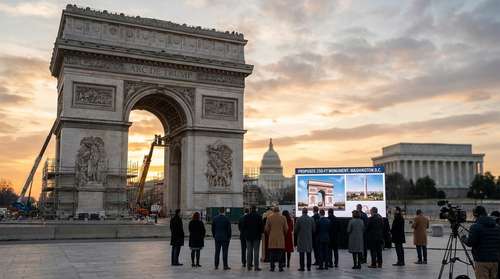
Planners have slated the Trump administration monument for Memorial Circle, an undeveloped traffic roundabout situated on the Virginia side of the Potomac River. Positioned precisely between the Lincoln Memorial and Arlington National Cemetery, the arch would instantly dominate the local landscape. Standing more than twice as high as the 99-foot Lincoln Memorial, the sheer size of the structure is a deliberate architectural choice intended to cement a lasting Trump presidential legacy ahead of the United States semiquincentennial. The president has repeatedly argued that the capital first sought such a monument 200 years ago, claiming the initial effort was interrupted by the Civil War.
The New Federal Monument Controversy: Sightlines and Flight Paths
While conservative supporters view the Washington DC triumphal arch as a bold tribute to American resilience and military sacrifice, the aggressive push to construct it has generated immense backlash from urban planners and historians alike. The most vocal opposition stems from the project's heavy-handed geographic footprint.
Military veterans have already filed lawsuits to halt the construction, arguing that the colossal monument will permanently alter the solemn, unobstructed sightlines from Arlington National Cemetery. Historic preservationists share these grave concerns, warning that dropping a 250-foot megalith into this delicate corridor will dwarf existing tributes and irreparably distort the area's visual harmony. Furthermore, aviation experts have raised serious red flags because the Memorial Circle location sits directly along the critical approach flight path for nearby Reagan National Airport, creating potential logistical and safety hurdles for commercial airlines.
Taxpayer Dollars and the 2026 Budget
Intense scrutiny regarding Trump administration spending 2026 has only added fuel to the fire. While the White House recently indicated that a combination of public and private funds would cover the as-yet-uncalculated total cost, American taxpayers are already on the hook for millions. Spending plans from the National Endowment for the Humanities, recently approved by the Office of Management and Budget, show that at least $2 million in special initiative funds and $13 million in matching funds have been reserved explicitly for the arch's early development phases. Critics on Capitol Hill argue this is an exorbitant vanity project that siphons crucial resources away from more pressing civic needs.
Reshaping National Mall Architectural Designs
The arch represents the administration's most aggressive effort to leave a permanent mark on the capital's urban planning, fundamentally altering legacy national mall architectural designs. During his second term, the president has frequently expressed frustration that Washington is the only major world capital lacking a massive triumphal arch.
The current push sidesteps traditional urban planning timelines, leveraging a newly reconstituted U.S. Commission of Fine Arts. Following the controversial dismissal of several sitting commissioners last year, the advisory panel is now largely staffed with presidential loyalists expected to fast-track the review process during their upcoming April 16 meeting.
Whether this ambitious and highly polarizing piece of architecture actually breaks ground remains deeply uncertain. Between the ongoing federal court challenges from veterans' groups, stringent aerodynamic evaluations by aviation authorities, and fierce public outcry, the administration faces a steep and complicated uphill battle. For now, the latest Arc de Trump renderings serve as a striking visual manifesto of a government determined to etch its aesthetic and ideological vision into the bedrock of the nation's capital.