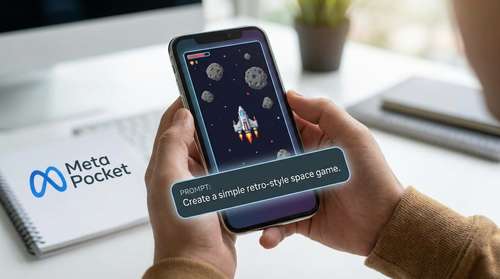
The landscape of game development is undergoing a massive shift, and the latest catalyst has arrived without a traditional press release. In late June 2026, tech giant Meta quietly soft-launched a new experimental platform known as the Meta Pocket app. This innovative mobile application empowers everyday smartphone users to instantly generate, play, and share interactive mini-games—completely eliminating the need for traditional programming. By simply typing natural language descriptions, creators can bring their digital imaginations to life.
This groundbreaking approach to software creation is commonly referred to as "vibe coding." While early iterations of vibe coding allowed developers to prototype web apps faster, Meta is now pulling vibe coding AI games out of developer-exclusive circles and dropping the concept directly into a consumer-friendly social feed. The result is a highly accessible platform where you can build fully functional experiences just by telling the artificial intelligence what you want to see.
What Exactly Are Meta AI Gizmos?
At the heart of this new ecosystem are what the company officially calls gizmos. A gizmo is an interactive, playable AI-generated experience built entirely from a single text prompt. Instead of spending months learning complex game engines like Unity or Unreal Engine, users can simply describe an idea. For instance, an early user could type, "turn a flower into a paintbrush so I can draw with it," and the app's generative AI immediately constructs a playable, interactive version.
The capabilities of these AI generated mini games extend far beyond static visuals or simple text outputs. According to the app's official support documentation, gizmos are designed to deeply integrate with modern smartphone hardware. When users create games with text prompts, those creations can feature:
- Motion sensing: Games that react to phone tilt, shaking, and device orientation.
- Touch controls: Puzzles and art boards that respond dynamically to dragging and swiping.
- Multimedia integration: Custom sound effects, background music, and direct access to a user's camera or photo library.
- Voice input: The ability to speak into the device microphone to trigger in-game events.
How to Create Games With Text Prompts on Pocket
The user journey for no code game development in Pocket is remarkably straightforward. Users tap a central create button, enter a highly descriptive prompt outlining their desired mini-game, and let the integrated AI formulate the backend coding. Once the application generates the gizmo, the creator can thoroughly test it, manually tweak the design settings, and publish it directly to their public profile.
A Social Feed Built on Remixing
Pocket operates as a vibrant social network reminiscent of modern short-form video platforms, but tailored specifically for interactive toys and casual gaming. The interface features a scrollable discovery feed where users can browse, play, and like the interactive content made by people around the world.
One of the standout social mechanics is the ability to "remix" existing content. If an original creator toggles the remix permission on, any player who discovers that gizmo in their feed can clone it. They can then adjust the original text prompt to add their own creative spin, change the mechanics, and publish a brand-new variation. This continuous loop of iteration makes building AI games a highly collaborative community experience.
The Roots: The Meta Gizmo Acquisition
While the Meta Pocket app seemingly appeared on digital storefronts overnight, its underlying architectural framework has a compelling backstory. The core technology powering this platform stems from a strategic Meta Gizmo acquisition earlier this year.
In March 2026, Meta hired the engineering team behind Atma Sciences Inc., a tech startup that had previously developed an early prompt-to-game platform called Gizmo. Alongside the talent acquisition, Meta secured a non-exclusive license to the startup's proprietary technology. By merging Atma Sciences' foundational work with Meta's own robust generative AI systems, the company successfully repackaged the vibe coding experience into this new, polished application.
The Future of No-Code Game Development
Initially spotted by app intelligence researchers and reverse engineers on June 29, 2026, the application is currently navigating a quiet, phased rollout on both the iOS App Store and Google Play. Availability remains restricted in several major markets, including the United States, as Meta continues to monitor server load, evaluate community moderation protocols, and refine the generative models.
Despite the currently limited access, the broader implications of Pocket's soft launch are massive. By dropping the technical barriers to entry to zero, the social media giant is positioning itself at the absolute forefront of user-generated entertainment. As artificial intelligence continues to evolve from producing static text and videos to rendering fully playable, interactive environments, casual game development could soon become as commonplace as snapping a photo. The entire tech industry is now watching closely to see if pocket-sized vibe coding will permanently disrupt how digital experiences are made.