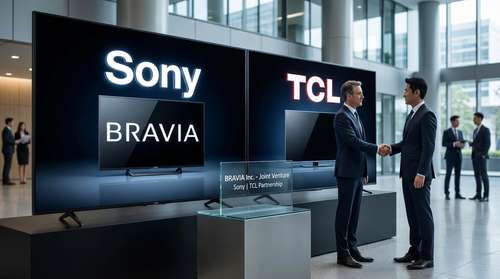
The landscape of home entertainment has officially shifted. As of April 1, 2026, the highly anticipated Sony TCL partnership has transitioned from a memorandum of understanding into a legally binding reality. In a move that fundamentally reshapes the premium television market, TCL Electronics has secured a 51% majority stake in Sony's home entertainment hardware division. This definitive agreement establishes a newly formed entity named BRAVIA Inc., blending Japanese engineering heritage with massive Chinese manufacturing scale.
The Anatomy of the TCL Electronics Sony Deal
Valued at an estimated 102.8 billion yen (approximately $644 million), the joint venture represents a massive operational transfer. TCL is investing roughly 75.4 billion yen ($473 million) to assume management control, fundamentally changing how one of the world's most recognizable consumer electronics brands operates. Despite the majority acquisition by TCL, the new company will remain headquartered at Sony’s Osaki office in Tokyo, preserving a critical link to its corporate roots.
Sony veteran Kazuo Kii has been appointed as Representative Director, Chairperson, and CEO of BRAVIA Inc., which will officially commence operations in April 2027. Corporate governance will feature a balanced board of four directors, split evenly between the two tech giants. This strategic leadership structure ensures that while TCL runs the operational engine, the legacy brand's DNA remains intact.
BRAVIA Inc. will not just manufacture televisions. The sweeping agreement encompasses Sony's entire home entertainment portfolio. This includes professional B2B flat panel and LED displays, legendary home theater projectors, and a wide array of audio components such as soundbars and home theater systems. It is a wholesale transfer of the living room hardware ecosystem.
Driving the Sony Business Restructuring 2026
To understand the logic behind this corporate marriage, you have to look at modern supply chain economics. The Sony BRAVIA TV joint venture allows both organizations to lean into their respective strengths. Sony provides decades of industry-leading picture processing technology, high-end audio engineering, and immense premium brand equity. In exchange, TCL brings its massive, vertically integrated display manufacturing infrastructure through its CSOT subsidiary, delivering unmatched end-to-end cost efficiency.
As part of this comprehensive offloading of hardware logistics, TCL will acquire 100% of Sony EMCS Malaysia, a critical facility for BRAVIA TV manufacturing. Additional negotiations are currently underway regarding the transfer of specific Chinese manufacturing assets, including Shanghai Suoguang Visual Products.
A Broader Sony Software Pivot
This transition highlights broader consumer electronics market trends, where traditional hardware margins are increasingly squeezed by intense global competition. By offloading the capital-intensive manufacturing and logistics of televisions and projectors, Sony frees up resources to focus on high-margin sectors. This aligns perfectly with an ongoing Sony software pivot toward gaming, entertainment properties, image sensors, and content distribution—sectors where the company continues to post record profits.
What This Means for the Living Room
If you are planning to upgrade your home theater setup, the immediate impact will be largely invisible. Both companies have confirmed that future displays and audio components will continue to proudly bear the Sony and BRAVIA badges.
For years, South Korean giants Samsung and LG have dominated the global television market by controlling their own panel manufacturing. The new joint venture creates a formidable third pillar capable of challenging that duopoly head-on. TCL already holds a massive share of global TV shipments by volume, while Sony commands a disproportionate share of the premium, high-margin market. Merging TCL’s sheer volume with Sony’s prestige could rapidly disrupt the current hierarchy.
The most pressing technical question for videophiles concerns OLED technology. Sony has consistently produced some of the market's best OLED televisions. Conversely, TCL has aggressively championed Mini-LED and QLED technologies, rarely showing interest in traditional OLED formats. How BRAVIA Inc. navigates this divergence will shape the high-end TV market for years to come. Will we see more aggressively priced Mini-LED Sony sets, or will the Tokyo-based engineering team maintain the brand's commitment to OLED flagships?
Ultimately, this partnership ensures the survival and evolution of the iconic BRAVIA lineup. By combining forces, Sony and TCL are creating a powerhouse capable of navigating an unpredictable consumer tech landscape, ensuring that premium picture quality remains accessible in living rooms worldwide.