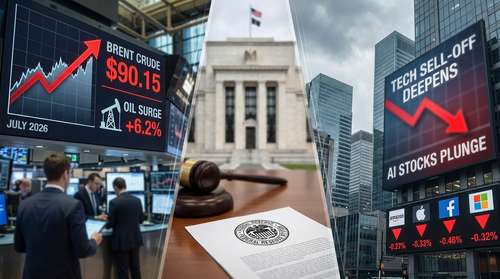
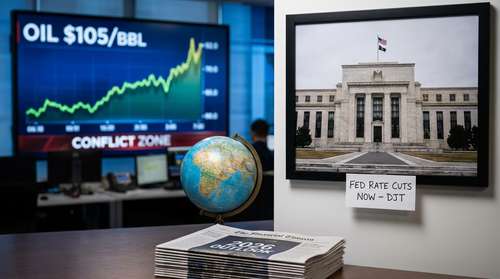
The geopolitical landscape has dramatically shifted following the late-February military strikes on Iran, sending immediate shockwaves through the global economy. With the vital Strait of Hormuz heavily disrupted, the resulting spike in Iran conflict oil prices 2026 has pushed Brent crude past the $100-per-barrel mark. The sudden energy crisis is squeezing American consumers and businesses alike, prompting intense political pressure from the White House as markets brace for sustained volatility.
Trump Targets Federal Reserve Interest Rates
As the economic fallout intensifies, President Donald Trump has escalated his public campaign against the U.S. central bank. In a recent Truth Social post, the president directly attacked Fed Chair Jerome Powell, demanding drastic action to buffer the domestic economy from the geopolitical shock.
"Where is the Federal Reserve Chairman, Jerome 'Too Late' Powell, today? He should be dropping Interest Rates, IMMEDIATELY, not waiting for the next meeting," Trump wrote, expressing frustration over the rising costs burdening American taxpayers.
The clash over Trump Federal Reserve interest rates policy comes at a critical juncture, just ahead of the Federal Open Market Committee's scheduled March 17 meeting. While the White House pushes for monetary relief to stimulate growth, the bond market is moving in the exact opposite direction. Before the U.S. and Israeli strikes began on February 28, traders had priced in two rate cuts for the year; today, futures markets are barely pricing in a single reduction. Investors are increasingly betting that the inflationary pressures of the conflict will force the Fed to keep rates elevated. This tension persists even as markets prepare for Kevin Warsh, Trump's nominee for Fed Chair, to potentially take the helm when Powell's term ends in May.
Surging Energy Costs 2026: Diesel and Gas Soar
The immediate pain of the Middle East conflict is being felt most acutely at the pump. The closure of the Strait of Hormuz—a crucial maritime corridor that handles roughly one-fifth of the world's oil supply—was recently reinforced by Iran's new Supreme Leader, Mojtaba Khamenei. This blockade is the primary driver behind surging energy costs 2026.
Retail gasoline averages have rapidly climbed to around $3.48 per gallon nationwide, marking a nearly 50-cent jump in just a few weeks. However, the industrial sector faces an even steeper climb. The highly anticipated diesel price hike 2026 has materialized with stunning speed, as national diesel averages skyrocketed to $4.81 per gallon—an increase of $1.07 since March 1.
"Diesel is essential for trucks, agriculture, and construction," noted Patrick DeHaan of GasBuddy. "Sharp increases like this affect the entire economy". Because commercial farming relies on diesel-powered equipment and logistics networks depend on heavy-duty trucking, these elevated transport costs are expected to rapidly bleed into the prices of everyday consumer goods and groceries.
US Airfare Price Increases Hit Travelers
The transportation sector's struggles extend far beyond the highways. Jet fuel prices have surged by as much as 64% over the past month, obliterating airline operating budgets. Because fuel accounts for roughly a quarter of a carrier's total expenses, airlines are already passing these premiums onto passengers.
Willie Walsh, director general of the International Air Transport Association (IATA), warned that the industry could see structural US airfare price increases averaging 8% to 9% if the military engagements do not reach a swift conclusion. "The problem for airlines is always volatility, the speed at which the price of oil changes," Walsh explained.
Several major international carriers, including Air France-KLM and Qantas, have already implemented fuel surcharges ranging from $10 to $200 per ticket depending on the route, signaling a frustrating and expensive travel season for millions of passengers.
Global Economic Impact of the Iran War
Beyond consumer travel and daily commutes, the broader global economic impact Iran war disruptions are flashing warning signs for a potential recession. Economists are openly discussing the risk of a 1970s-style stagflation scenario—a damaging economic condition characterized by stagnant corporate growth coupled with persistently high inflation.
Financial firms are modeling dire scenarios if the conflict drags on. According to middle-market firm RSM, if crude oil prices sustain levels around $125 a barrel, it could shave 0.8% off U.S. gross domestic product while pushing inflation past 4%. For anyone monitoring business news market volatility, the timeline for a resolution remains worryingly opaque. While President Trump has confidently stated the conflict will end "when I feel it in my bones," energy analysts caution that even a temporary blockade of the Persian Gulf creates a domino effect. Should production in the Gulf states be forced to pause due to shipping bottlenecks, crude could theoretically be driven toward $150 a barrel, causing lasting damage to the global supply chain.