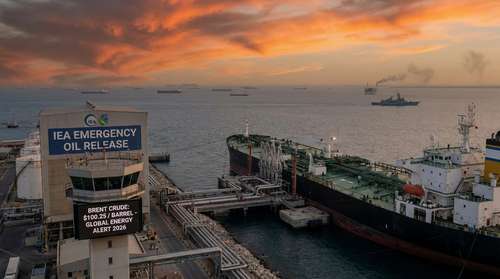
The global energy sector is facing an unprecedented structural shock this week. In response to skyrocketing costs, the International Energy Agency authorized a historic IEA emergency oil release of 400 million barrels. The coordinated intervention aims to stabilize international markets after a massive 10-million-barrel daily supply loss triggered a sharp spike in the Brent crude price today. With futures briefly surging past the $100-per-barrel threshold, governments worldwide are scrambling to mitigate the economic fallout of the sudden supply freeze.
The action, finalized late Wednesday, marks the largest emergency stockpile deployment since the agency's founding in 1974. By coordinating across its 32 member nations, the organization hopes to bridge the yawning gap between global demand and a severely constrained petroleum output.
The Catalyst: A Historic Strait of Hormuz Oil Disruption
The immediate trigger for this week's intervention stems directly from intensifying geopolitical conflict in the Middle East. Maritime traffic has essentially ground to a halt through the Persian Gulf's most vital corridor, resulting in a severe Strait of Hormuz oil disruption. Under normal conditions, this narrow 29-nautical-mile waterway serves as the transit route for approximately 20 million barrels per day—accounting for roughly 20% of the world's total petroleum liquid consumption.
Recent military escalations and the withdrawal of war-risk insurance for commercial vessels have paralyzed the route. Analysts currently estimate the physical supply loss at a staggering 10 million barrels per day. Unlike other regional transit routes, the Strait of Hormuz has virtually no functional pipeline alternatives capable of offsetting a shutdown of this magnitude. Saudi Arabia and the UAE possess some bypass infrastructure, but their combined spare capacity hovers around 3.5 to 5.5 million barrels daily, leaving a massive deficit in the physical market.
For those tracking energy supply chain news, the speed of this bottleneck's impact on global logistics has been dizzying. Dozens of supertankers remain idled in the Gulf of Oman, unable to safely navigate the strait, effectively locking off a fifth of global supply from the open market.
Anatomy of the Record IEA Emergency Oil Release
Faced with the prospect of an immediate and crippling shortage, the 32 member nations of the IEA unanimously agreed to tap into their strategic reserves. The sheer scale of the 400-million-barrel deployment dwarfs all previous interventions. For context, the organization's previous record was a 182.7-million-barrel drawdown authorized in two phases during 2022 following the outbreak of war in Ukraine. This makes the current IEA emergency oil release more than double the size of any prior market intervention.
The collective stockpile of IEA members exceeds 1.2 billion barrels in public emergency reserves, supplemented by another 600 million barrels mandated in industry stocks. This aggressive new deployment utilizes roughly 22% of those government-held assets.
The Role of the U.S. Strategic Petroleum Reserve
The United States is shouldering the largest portion of the burden. The administration has committed to supplying approximately 172 million barrels from the Strategic Petroleum Reserve (SPR). Kept in massive underground salt caverns along the Gulf of Mexico, the U.S. SPR currently holds just over 415 million barrels.
Logistics dictate that extracting and delivering these reserves will take time. The maximum drawdown capability of the U.S. SPR tops out at 4.4 million barrels per day, meaning the authorized American volumes alone will take roughly 40 days of continuous operation to fully enter the physical market. Allied nations, including Japan and France, have pledged immediate supplementary releases to bridge the immediate delivery gap.
Navigating Extreme Oil Market Volatility
Financial markets reacted violently to the initial shipping freeze before paring back some gains following the IEA's announcement. The wild swings in the Brent crude price today reflect deep uncertainty among commodity traders regarding the duration of the Middle East conflict. Before the reserve deployment was confirmed, benchmark contracts easily eclipsed $100, threatening to trigger a broader global energy crisis 2026.
This level of extreme oil market volatility forces difficult choices for global central banks. Most developed nations have spent the past three years wrestling inflation down to target levels. A sustained spike in core energy costs threatens to reverse that progress overnight, potentially forcing policymakers to abandon planned interest rate cuts to prevent a secondary inflationary wave. Traders tracking the Brent crude price today note that risk premiums remain exceptionally high despite the reserve injection.
Evaluating the Gas Price Impact 2026
For everyday consumers, the macro-level supply shock translates directly to pain at the pump. The gas price impact 2026 is already materializing in wholesale markets, where refined product premiums have shot up significantly since Tuesday. If the Strait of Hormuz oil disruption drags on beyond a few weeks, retail gasoline and diesel prices will inevitably surge across North America and Europe.
Refineries are already warning that the lack of steady feedstock could force them to reduce capacity utilization, creating a localized shortage of motor fuels just as the spring driving season approaches. Governments have few tools to shield consumers from these retail spikes beyond suspending fuel taxes—a move several European nations are reportedly considering.
Looking Ahead: Bridging the Gap
While the monumental IEA emergency oil release provides a vital psychological and physical buffer, it is ultimately a temporary bandage. Emergency reserves are designed to buy time, not permanently replace structural baseline production. The long-term stability of the global energy sector relies entirely on the restoration of safe commercial navigation through the Middle East.
Energy analysts agree that unless diplomatic or military efforts succeed in reopening the Strait of Hormuz within the next two months, the coordinated reserve releases will eventually run dry against the 10-million-barrel daily deficit. Until those transit lanes are secured, the global economy remains in a precarious holding pattern, hostage to one of the most severe logistical disruptions in modern history.