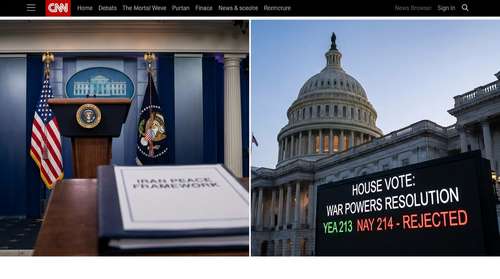
In one of the most dramatic legislative battles of the year, the U.S. House of Representatives narrowly rejected a critical measure aimed at restricting military action against Tehran. The House War Powers Resolution failed Thursday in a razor-thin 213-214 vote, delivering a precarious victory for the Trump administration. The showdown on Capitol Hill unfolds as President Donald Trump publicly insists a historic Trump Iran peace deal is imminent, a claim Iranian leadership has flatly rejected amidst mounting tensions over the ongoing U.S. maritime strategy.
A Nail-Biting Vote and the GOP Rebellion Congress Faced
The 213-214 floor vote highlights deep fractures within Washington regarding the administration's aggressive posture in the Middle East. To pass, the resolution required a simple majority, but intense eleventh-hour lobbying by White House officials managed to hold just enough Republican defectors at bay. Even so, the vote exposed a notable GOP rebellion Congress must now navigate. Several conservative lawmakers, citing constitutional concerns, joined Democrats in expressing alarm over executive overreach and the risk of unmanaged escalation.
Supporters of the House War Powers Resolution argued the measure was absolutely necessary to prevent the U.S. from stumbling into a protracted, unauthorized conflict. The legislation specifically targeted funding and authorization for current operations, seeking to rein in the commander-in-chief's unilateral military options. By failing to pass, the House essentially punted the decision, leaving the current military framework untouched but highly scrutinized.
US-Iran Negotiations: Are We 'Very Close' to a Deal?
Immediately following the vote, President Trump took a victory lap, projecting immense optimism about the diplomatic track. Addressing reporters, he framed the legislative win as vital leverage, asserting that a comprehensive Trump Iran peace deal is "very close." The administration maintains that sustained maximum pressure has finally forced Tehran back to the bargaining table, ready to discuss long-term concessions regarding its nuclear ambitions and ballistic missile programs.
However, the reality of US-Iran negotiations appears far more complex. The diplomatic track recently faltered during the grueling 21-hour Islamabad summit over the weekend, where talks failed to solidify a fragile ceasefire. Within hours of the president's latest remarks, Iranian foreign ministry officials issued blistering statements labeling the peace claims "entirely false." Tehran insists no final draft exists and accuses Washington of fabricating diplomatic progress to placate domestic critics.
Disputed Terms and Ceasefire Violations
The stark disconnect between Washington and Tehran centers heavily on facts on the water. Iranian diplomats fiercely warn that the ongoing Iran naval blockade 2026 represents a blatant violation of the fragile ceasefire agreed upon earlier this year. Tehran has set the immediate lifting of the blockade as an absolute precondition for any formal treaty, a concession the White House currently refuses to make, viewing the naval presence as essential leverage.
Operation Epic Fury and the Strait of Hormuz Crisis
The military framework anchoring the administration's strategy, dubbed Operation Epic Fury, remains fully active and formidable. Originally launched in February to secure vital shipping lanes and deter proxy attacks, Operation Epic Fury has evolved into a comprehensive maritime dragnet. The sustained military presence has significantly exacerbated the Strait of Hormuz crisis, keeping global energy markets in a state of high anxiety.
The Iran naval blockade 2026, which officially began on April 13, heavily restricts maritime traffic moving in and out of crucial Iranian commercial ports. The escalation follows disputes over what maritime authorities dubbed the "Tehran Toll Booth," where Iran was allegedly charging exorbitant transit fees of $1 million per vessel. While U.S. Central Command insists the maneuvers are purely defensive and legally sound under international maritime law, global shipping conglomerates are feeling the squeeze. Insurance premiums for commercial vessels navigating the Persian Gulf have skyrocketed this week, reflecting widespread fears of asymmetric retaliation by the Islamic Revolutionary Guard Corps (IRGC).
What Comes Next for Regional Stability?
With the defeat of the House War Powers Resolution, the White House retains the broad authority needed to maintain Operation Epic Fury and the accompanying blockade. Yet, the one-vote margin serves as a stark political warning. The administration clearly lacks a sweeping mandate for further military escalation, and the narrow victory suggests that domestic patience is wearing thin.
If the highly touted Trump Iran peace deal fails to materialize in the coming weeks, the administration will face renewed congressional scrutiny. Lawmakers have already signaled that a continued standoff could prompt another, stronger legislative push to curb executive war powers. For now, the situation in the Middle East remains a volatile waiting game. The global community watches closely, well aware that a single miscalculation in the Strait of Hormuz crisis could shatter the current fragile ceasefire and plunge the region back into open, unpredictable conflict.