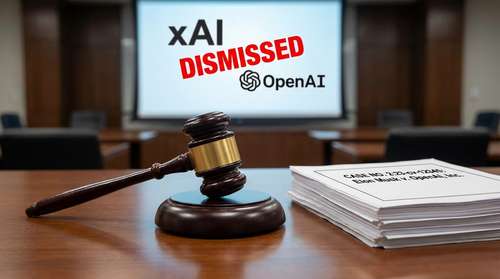
A federal judge has dismissed a high-profile trade secret lawsuit filed by Elon Musk’s artificial intelligence company, xAI, against rival OpenAI. In a ruling handed down on Tuesday, U.S. District Judge Rita F. Lin tossed out the case, which alleged that the ChatGPT maker had orchestrated a "strategic campaign" to steal confidential source code and trade secrets by poaching key employees. The decision marks a significant legal setback for Musk in his multi-front battle against Sam Altman’s AI giant.
Judge Finds No Evidence of Corporate Misconduct
The dismissal centers on a critical lack of evidence linking the actions of individual employees to OpenAI’s corporate leadership. Judge Lin ruled that while xAI may have valid claims against specific former employees for alleged theft, the company failed to substantiate its accusation that OpenAI itself induced the misconduct or utilized any stolen secrets.
"Notably absent are allegations about the conduct of OpenAI itself," Judge Lin wrote in her decision. She emphasized that xAI did not provide facts indicating that OpenAI encouraged the theft or that the stolen trade secrets—specifically related to the Grok chatbot—were ever used by the defendant. The judge noted that the mere fact that approximately eight employees left xAI for OpenAI around the same time does not inherently constitute an illegal conspiracy or corporate theft.
Allegations of Source Code Theft and "Grok" Secrets
The lawsuit, originally filed in September 2025, painted a dramatic picture of corporate espionage in Silicon Valley. xAI alleged that former engineers, including Xuechen Li and Jimmy Fraiture, illegally downloaded terabytes of confidential data before jumping ship to OpenAI. Specifically, Li was accused of copying the entire source code for xAI’s "Grok" model, along with sensitive files labeled "Grok-inference" and "Future-Model-Tests," to personal devices just days before his resignation.
According to court filings, xAI claimed Li sold approximately $7 million in company stock shortly before allegedly transferring the data. Another employee, Jimmy Fraiture, was accused of using AirDrop to transfer source code and a recording of a confidential all-hands meeting to a personal device. Despite these detailed accusations against individuals, the court found that xAI failed to connect these actions to a directive from OpenAI’s management.
Opportunity to Refile
The legal battle is not entirely over. Judge Lin dismissed the case "with leave to amend," giving xAI until March 17, 2026, to refile its complaint. To succeed, Musk’s legal team must present new evidence demonstrating that OpenAI actively solicited the theft or knowingly benefited from the stolen trade secrets. If they cannot bridge this evidentiary gap, the dismissal could become permanent.
Broader Legal War: Musk vs. Altman
This ruling is just one skirmish in a much larger legal war between Elon Musk and Sam Altman, the CEO of OpenAI. The two tech moguls, who co-founded OpenAI in 2015, have been locked in a bitter feud over the company’s direction. Musk has accused OpenAI of betraying its original non-profit mission to benefit humanity by pivoting to a for-profit model heavily tied to Microsoft.
A separate, even higher-stakes trial regarding OpenAI’s non-profit transition is scheduled to begin in late April 2026. in that case, Musk is seeking a staggering $134.5 billion in damages, arguing that he was defrauded into investing millions during the company's early years. While the trade secret lawsuit has hit a roadblock, the upcoming trial promises to keep the rivalry between these AI heavyweights in the global spotlight for months to come.