The era of collecting colorful ink in your passport is officially coming to a close. As of this week, European officials confirmed the highly anticipated EU Entry/Exit System 2026 will become 100% operational across all 29 member nations on April 10. The sweeping technological overhaul replaces manual document checks with a massive digital database, and the results are already causing shockwaves. New data released today reveals the system has flagged over 4,000 visa violators during its final rollout phase, signaling a strict, automated enforcement of the continent's immigration policies.
The Final EES Rollout Deadline
First introduced in a phased approach on October 12, 2025, the digital network has been gradually scaling up operations at major airports, ports, and land crossings. Now, border authorities are bracing for the final EES rollout deadline on April 10, 2026. By this date, every non-EU traveler will be processed exclusively through the digital framework.
For decades, border agents relied on a quick visual scan of entry dates to determine if visitors were complying with immigration laws. With passport stamps ending 2026, that analog verification is officially obsolete. Instead, every arrival and departure will be registered in a centralized biometric database shared across the Schengen Area. The transition represents the most significant transformation of European travel infrastructure since the abolition of internal borders in 1995, shifting the burden of compliance entirely onto an automated digital ledger.
Enforcing Schengen Overstay Rules 2026
The most immediate impact of the new technology is its ruthless efficiency in tracking exact visitor time limits. Under the strict Schengen overstay rules 2026, third-country nationals—including tourists from the United States, Canada, and the United Kingdom—are permitted to stay in the zone for a maximum of 90 days within any 180-day period. Historically, accurately tracking those rolling timelines across multiple countries was a logistical nightmare for authorities.
Not anymore. The 4,000 overstayers caught in the last four months were identified automatically by the new software, which flags border guards the exact moment a traveler scans their document if they have exceeded their allotted time. Before this network went live, measuring overstay rates with any precision was nearly impossible because the data didn't exist in a digitized, cross-referenced format. Now, the European Commission has real-time data on exactly who is breaking the rules, when, and for how long. Violators face serious consequences, ranging from steep fines and immediate deportation to multi-year entry bans.
Europe Travel Requirements for Americans and Brits
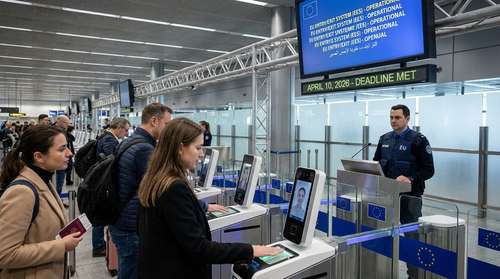
The software update radically alters standard Europe travel requirements for Americans and other visa-exempt nationals. When you arrive at an external Schengen border—whether landing at Rome's Fiumicino or taking the Eurostar from London St Pancras—you will be directed to self-service kiosks before speaking to a border officer. You will need to scan your passport, submit to a facial recognition snapshot, and provide electronic fingerprint scans. Once registered, your biometric profile remains valid in the system for three years.
Navigating EU Digital Border Delays
While the European Commission touts the system as a critical tool for enhanced security and long-term efficiency, the short-term reality has been notoriously rocky. Comprehensive Europe biometric border checks require processing a massive amount of data, and the hardware has faced significant teething problems. During the initial scale-up earlier this year, several major transport hubs, including Paris-Charles de Gaulle and Lisbon, reported software glitches and severe understaffing at automated gates.
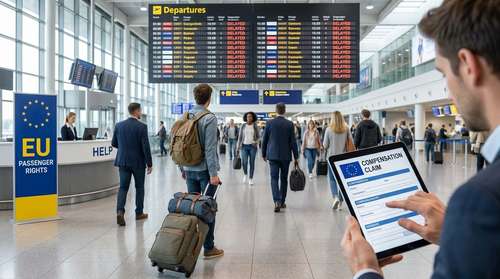
Airlines and aviation industry groups have repeatedly warned about impending EU digital border delays as the Easter holiday and summer travel seasons approach. Travelers have reported waiting up to three hours at select checkpoints where authorities have been running double-entry systems—both stamping passports and processing biometric data simultaneously to stress-test the infrastructure. While the physical stamping will end entirely on April 10, the legal requirement to register 100% of third-country arrivals through the digital kiosks could still create major bottlenecks during peak transit hours.
Looking Ahead: The ETIAS Rollout
It is crucial to understand that the EU Entry/Exit System 2026 is only the first half of Europe's border modernization project. While the EES tracks physical movement at the border, the European Travel Information and Authorisation System (ETIAS) will require travelers to obtain digital pre-approval before they even board a flight. Authorities confirmed this week that ETIAS is still slated for the final quarter of 2026, meaning travelers will face another layer of bureaucracy later this year.
If you are planning a European vacation this spring or summer, border officials recommend arriving at departure terminals earlier than usual, particularly if you are crossing via the English Channel or flying into busy hubs. Ensure your travel documents are pristine, as the automated scanners are highly sensitive to damaged passport chips. The era of frictionless European entry has fundamentally changed, and preparation is now your best defense against travel disruptions.