Apple confirmed on Tuesday that it has selected Houston, Texas, as the new manufacturing hub for its Mac Mini line, a strategic move that underscores the tech giant's deepening commitment to American manufacturing. The announcement, which comes just hours before President Trump's scheduled State of the Union address, marks a pivotal moment in Apple's four-year, $600 billion investment pledge to bolster its domestic supply chain. By shifting production of the Mac Mini—a device increasingly favored for running local AI agents—from Asia to a retrofitted Foxconn facility in North Houston, Apple is not only securing its hardware future but also navigating the complex landscape of U.S. tech tariffs in 2026.
Houston: The New Silicon Stronghold
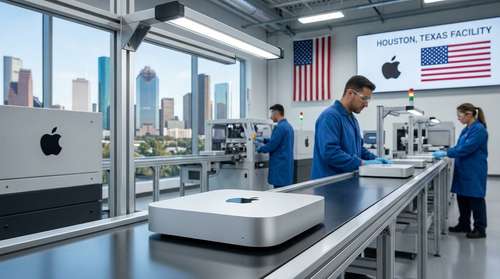
The decision to plant a flag in Houston represents a significant diversification of Apple's Texas footprint, which has traditionally centered around its Austin campus. Apple Chief Operating Officer Sabih Khan revealed the plans during a tour of the new site, a massive facility in North Houston operated by manufacturing partner Foxconn. The site features two primary structures: one already assembling Apple's AI servers, and a cavernous warehouse currently being converted into a 220,000-square-foot production line dedicated to the Mac Mini.
"We're very excited to tell you that later this year we will be beginning Mac Mini manufacturing right here in this space," Khan told reporters. This expansion aligns with a broader trend of tech giants flocking to the region; Nvidia is reportedly set to open an AI supercomputer facility nearby later this year, and Foxconn has already poured $450 million into its local AI server operations.
Fueling the Demand for Local AI Agent Hardware
While the Mac Mini has historically been considered a niche product within Apple's lineup—accounting for less than 5% of total Mac sales—its role has evolved dramatically in the era of ubiquitous artificial intelligence. The shift to Houston is directly driven by a surge in demand for local AI agent hardware. Developers and power users are increasingly deploying Mac Minis as dedicated, always-on personal servers to run complex AI models and "agentic" workflows locally, prioritizing privacy and latency over cloud dependence.
"Over time, we want to scale Mac Mini here to serve our customers in this area," Khan explained, noting that the Houston facility will initially assemble units to meet North American demand while Asian facilities continue to supply global markets. This "local-for-local" strategy allows Apple to cater specifically to the high-performance needs of the U.S. AI sector.
Navigating 2026 Tech Tariffs
The timing of this move is inextricably linked to the geopolitical climate. In May 2026, the Trump administration threatened a reinstatement of 25% tariffs on overseas-manufactured electronics, a policy shift that sent shockwaves through the tech industry. By accelerating American electronics manufacturing, Apple effectively insulates one of its most critical growth products from these potential levies.
Industry analysts suggest that this preemptive maneuver serves as a blueprint for how major tech firms will navigate trade tensions moving forward. "This is about risk mitigation as much as it is about patriotism," notes supply chain expert Dr. Elena Rosas. "By bringing final assembly of the Mac Mini to Houston, Apple avoids the 25% tariff penalty while simultaneously delivering a political win that fits perfectly with the administration's 'Made in America' mandate."
Strengthening the Apple Domestic Supply Chain
This initiative is a cornerstone of the Apple $600 billion investment plan announced last August, which aims to revitalize U.S. industrial capacity over four years. Unlike the 2013 attempt to manufacture Mac Pros in Austin—which faced scalability challenges—the Houston operation benefits from a more mature domestic supply ecosystem. Key components are now sourced closer to home, with partners like TSMC in Arizona and Corning in Kentucky playing integral roles.
The Houston facility will also house a new training center for advanced manufacturing, designed to upskill the local workforce in the precise automation techniques required for Apple's hardware. As the line between consumer desktop and AI server blurs, Apple Houston manufacturing is poised to become a critical node in the company's global infrastructure, proving that high-tech hardware can indeed be built at scale on American soil.